
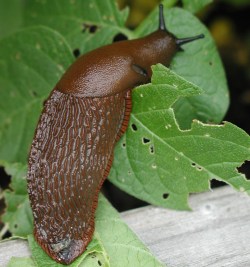
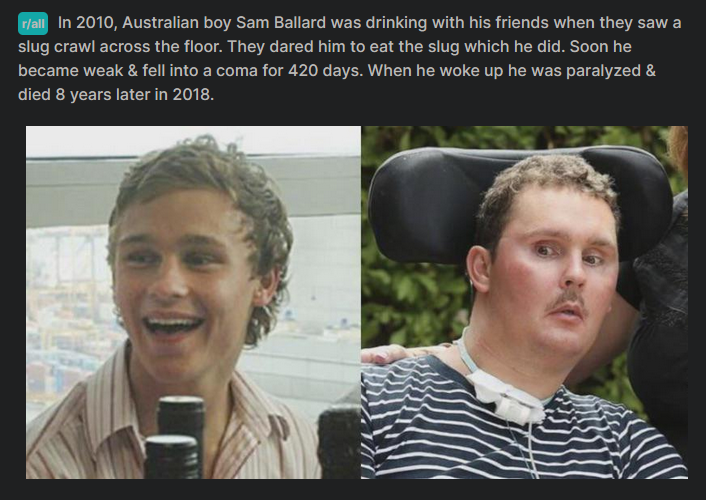
 In 2010, an Australian boy named Sam Ballard, aged 19, was hanging out and drinking with his fellow rugby players at a local party. A garden slug came crawling across the backyard patio, and as part of an alcohol fueled dare, Sam ate it. Swallowed the poor creature whole. After eating the slug, Sam developed health complications, the symptoms of which included pain in the legs and general weakness.
Shortly thereafter, Sam fell into a coma for 420 days. Eventually he woke up, but his body remained paralyzed while he was fully conscious of the world around him. He ate through a tube, and was unable to move without exerting great effort. He remained in this horrifying state, requiring 24/7 care, for 8 more years before passing on.
As it turned out, the slug that Sam ate on a dare was infected with the rat lungworm, Angiostronjilus cantonensis. Typically the worm would infect rats and lodge themselves in the rat’s lungs. The larval offspring of the worms would exit the rats through the digestive tract and be expelled along with the rat’s feces. When creatures such as slugs and snails consume the rat feces, the worms would be passed along to other animals in the ecosystem.
In the case of accidental (or intentional) consumption of food contaminated with the worms by a human, the larval worms would fail to exit the human body and end up up in the brain instead, causing eosinophilic meningitis – which is an inflammation of the membranes surrounding the brain and/or spinal cord.
 Typically symptoms are relatively mild and might include less exotic reactions such as headache, nausea, vomiting, and so on. Occasionally, though, truly catastrophic outcomes such as what happened to Sam would also occur.
For what it’s worth, Sam passed on back in 2018 while surrounded by those who loved him. The haunted expression on Sam’s face after he became paralyzed makes for a very sad contrast compared to the sunny, handsome teenager who was invincible to the whole world, the way he was before he ingested the slug that started all the heartbreak.
Originally from social media:
 Temple of Zagan